Key Takeaways
- Socialising an aggressive dog must be slow, structured, and centered on safety rather than forcing quick interactions or greetings with unfamiliar people and dogs.
- Aggression often stems from fear, stress, frustration, or lack of clear structure, not because a dog is “mean” or defiant.
- Forced greetings, crowded dog parks, and overwhelming public outings can make dog aggression and reactivity significantly worse over time.
- Calm exposure at a distance, strong leash control, and solid obedience skills like recall, place command, and focus exercises are essential foundations for safer socialisation.
- Professional behavior modification support is often necessary, especially for dogs with bite history or owners who feel unsafe during outings.
Introduction
Understanding how to socialize an aggressive dog requires a completely different approach than typical puppy socialization. The goal is not to force your dog to enjoy every person, dog, or situation they encounter. Instead, it is about creating calmer, safer behavior in real-world situations where your dog can observe and process the environment without feeling threatened or overwhelmed.
This guide covers:
- Why dog aggression requires careful, controlled exposure
- How to begin socialization training without forcing interactions
- The obedience skills that support safer behavior around distractions
- Warning signs that your dog needs foundational work before social exposure
- When professional guidance becomes necessary for effective behavior modification
Progress is absolutely possible with patient, step-by-step training. Safety for you, other dogs, other people, and your own dog always comes first.
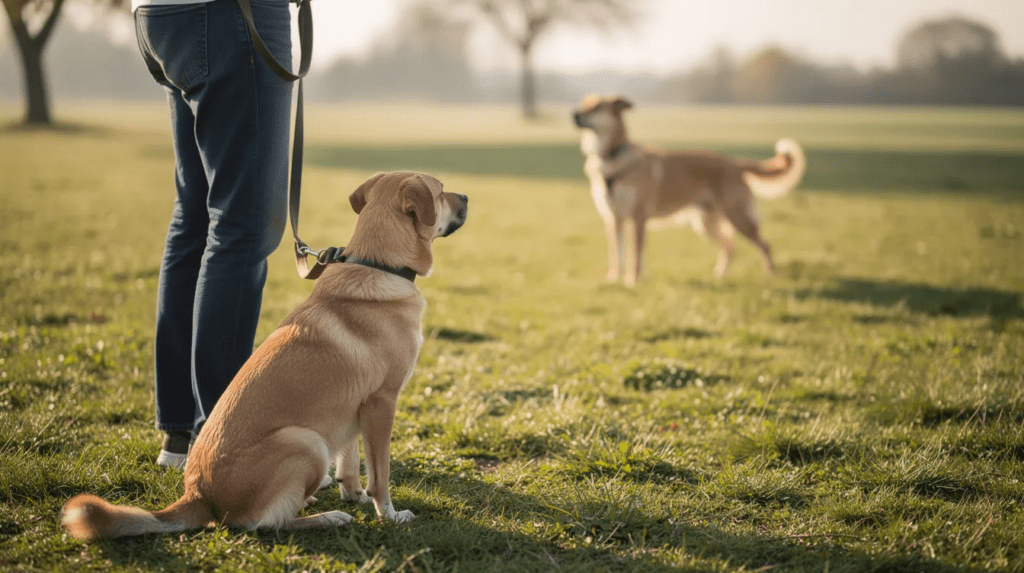
Why Socialising an Aggressive Dog Requires Care
An aggressive dog cannot be socialized the same way as an easygoing puppy or a naturally social adult. The strategies that work for friendly dogs can actively make things worse for dogs struggling with reactivity or aggression.
Understanding the Roots of Aggressive Behavior
Aggression in dogs is often a symptom of underlying fear or stress, not a permanent diagnosis or evidence that your dog is fundamentally “bad.”
Many canine aggression cases are rooted in:
- Fear: The dog perceives a threat and reacts defensively
- Frustration: Being restrained on a leash when they want to approach or escape
- Stress: Chronic anxiety from inconsistent routines or unmet needs
- Poor past experiences: Negative encounters with other dogs, strangers, or overwhelming environments
- Lack of structure: Unclear rules and boundaries create uncertainty and anxiety
Fear-based aggression often arises when dogs perceive a threat to themselves, their owner, or their space. Common triggers can include other dogs, strangers, unfamiliar sounds, sudden movement, or stressful environments. Aggression does not always come from past abuse or one obvious bad experience. Some dogs become reactive because they feel unsafe, overwhelmed, restrained, or unsure how to respond.
Fear-based aggression can appear even when there is no obvious history of abuse or trauma. Some dogs become fearful because of genetics, limited early exposure, painful experiences, repeated stress, or situations that make them feel trapped or unsafe. Some dogs may react more strongly when they are on leash, near their owner, or in familiar territory. This does not always mean they are being protective. It may reflect fear, frustration, stress, guarding behavior, or a learned pattern that has been repeated over time.
Why the Critical Window Matters
Socialization is meant to be pre-emptive exposure to things that dogs will encounter throughout their lives, helping them acclimatize to the world around them. The critical window for puppy socialization is between 3 to 14 weeks, during which puppies should be exposed to various stimuli to build confidence and reduce fear later in life.
For adult dogs who missed this window or developed aggression issues later, the approach must change entirely. Adult reactive dog training requires counter-conditioning and desensitization rather than broad, unstructured exposure.
Reactivity Versus Aggression
Understanding the difference matters for your training plan:
| Reactivity | Aggression |
| An exaggerated response to everyday stimuli, often caused by fear, frustration, excitement, or feeling overwhelmed. | Threatening or harmful behavior such as growling, snapping, lunging, or biting. It may be defensive, fear-based, territorial, pain-related, resource-related, or frustration-based. |
Most reactive dogs do not actually want to fight or hurt anyone. They are just overwhelmed by their environment. However, reactivity can escalate into aggression if not addressed, making early intervention crucial for managing a dog’s behavior.
Why Forced Greetings Backfire
When an aggressive or highly reactive dog is pushed into busy public spaces or crowded dog parks, they often feel trapped, cornered, or out of control. This is exactly when dangerous behavior happens.
Every time your dog barks, lunges, or snaps in these environments, the behavior can become more practiced and harder to interrupt. Instead of learning to feel safe, the dog may learn that reacting strongly creates distance or ends the stressful situation. This is why repeated uncontrolled exposure can make reactivity worse.
Uncontrolled multi-dog environments can be especially difficult for reactive or aggressive dogs because they involve sudden approaches, limited space, and unpredictable behavior from other dogs. Structured training gives the dog more distance, clearer expectations, and a safer way to practice calm behavior.
Fear-based aggression can escalate if a dog feels their owner is not capable of keeping them safe, leading to a loss of trust in their handler. When you force interaction with a fearful dog, you risk damaging the bond and trust that behavior modification depends on.
Safe socialization for a dog with known dog aggression or bite risk must be planned and controlled, not left to chance encounters on sidewalks, in pet stores, or at crowded hiking trails.
The contrast is clear:
- Calm exposure and structure supports genuine behavior modification
- Chaotic, uncontrolled social time strengthens problem behaviors
How to Start Safely Without Forcing Interactions
Learning how to socialize an aggressive dog safely always begins with one principle: start at a distance where your dog can remain calm.
Understanding Threshold
Proper socialization requires understanding a dog’s triggers and ensuring they are kept under threshold to prevent rehearsing undesirable behaviors. The threshold is the closest distance to people, dogs, or other triggers where your dog can still:
- Stay physically relaxed
- Accept treats willingly
- Look at you when asked
- Disengage from the trigger without stress signals
For highly reactive cases, this threshold distance might be 50 to 100 feet or even more. That is completely normal and nothing to feel discouraged about.
Identifying a dog’s threshold distance is crucial. This is the closest distance to a trigger before the dog starts showing signs of stress. When you know where this line is, you can work just outside of it where learning happens.
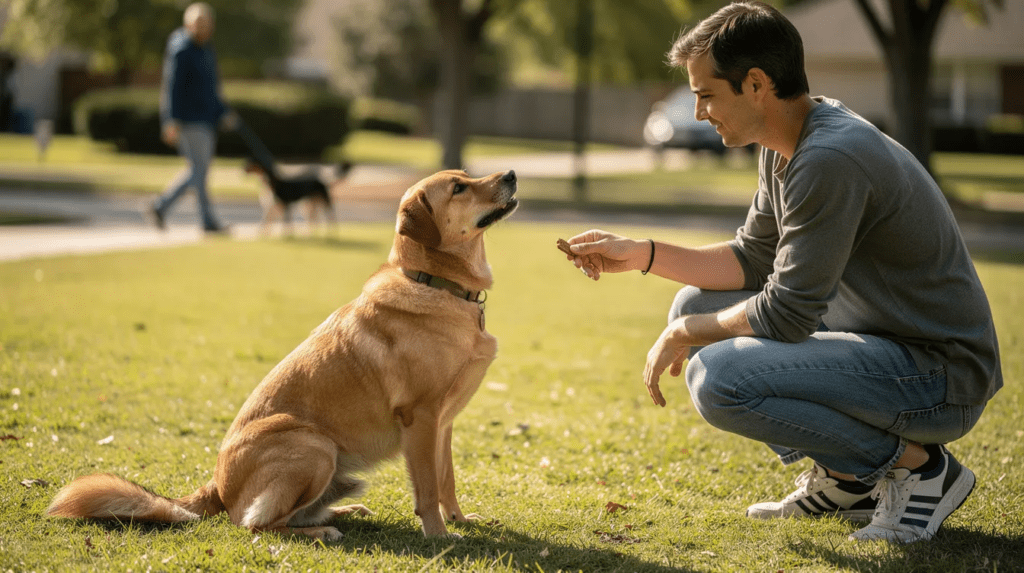
Choosing Controlled Environments
Socialising an aggressive or reactive dog requires a structured, safety-first approach centered on changing the dog’s emotional response to triggers rather than just suppressing outward symptoms.
Start in environments where you have maximum control:
- Quiet parking lots during off-peak hours
- Open fields with clear sightlines
- Empty parks early in the morning
- Private fenced areas you can rent for exclusive use
These controlled environments allow you to:
- See triggers coming from a distance
- Move away quickly if needed
- Maintain safe space between your dog and others
- Practice without unpredictable interruptions
Avoid busy pet stores, crowded vet waiting rooms, or Saturday morning dog walking routes when starting this work.
The Power of Calm Exposure
Early sessions should focus entirely on calm exposure. Your dog watches other dogs or people from a safe distance without any requirement to greet or interact. No direct contact needed.
To change a dog’s emotional response to triggers, controlled exposure from a safe distance is essential, rewarding calm behavior with high-value treats. This is where counter-conditioning comes in. Counter-conditioning pairs the presence of a trigger with high-value rewards, helping the dog associate previously “scary” things with positive experiences.
Use treats that are 10 times more motivating than regular kibble:
- Small pieces of chicken
- Cheese
- Hot dogs
- Whatever makes your dog’s eyes light up
The goal is simple: when your dog sees another dog or person at a distance, good things happen. Over time, this shifts the dog’s emotional response from negative anticipation to positive associations.
With consistent practice, many dogs begin to recover faster, respond better to cues, and show fewer intense reactions around triggers. Progress depends on the dog’s history, the severity of the behavior, the owner’s consistency, and whether the training stays below the dog’s threshold.
Gradual Exposure Done Right
Desensitization involves gradually exposing your dog to triggers from a distance where they notice them but stay calm, decreasing this distance only as the dog remains relaxed.
A practical example: A reactive dog may need to begin training far away from another dog, sometimes across a field or parking lot. The owner can reward calm glances, relaxed body language, and checking in. Over time, the distance may gradually decrease as long as the dog stays calm, responsive, and able to take rewards.
Parallel walks work well for gradually exposing your dog to other dogs:
- Walk in the same direction as another calm dog
- Maintain 50 or more feet of distance
- No face-to-face interaction
- Both dogs can observe without confrontation
What to Avoid: Flooding
Never take an aggressive dog straight into:
- A crowded dog park
- A busy Saturday market
- A packed pet store
- A chaotic vet waiting room
This approach is often called flooding, and it can backfire badly. Overwhelming a dog with intense exposure may increase fear, panic, or defensive behavior instead of helping the dog feel safer. If the dog cannot think, take treats, or respond to cues, the situation is too difficult and should be made easier.
Not all dogs will ever enjoy close contact with strange dogs or unfamiliar people. That is okay. A happy dog is one who feels safe, not one forced into uncomfortable situations.
Session Structure
Keep training sessions:
- Short: 5 to 15 minutes maximum
- Frequent: 3 to 5 times weekly
- Safe: End on a high note before overwhelm
Long, exhausting outings that push your dog past the threshold do more harm than good. Brief, positive experiences build confidence. Overwhelming experiences build fear.
Obedience Skills That Support Safer Socialisation
Dog obedience forms the structural backbone of safer socialization. Without reliable skills, every encounter with distractions becomes unpredictable and potentially dangerous.
Consistent training sessions are necessary to establish clear boundaries and reduce anxiety in aggressive dogs. When your dog knows exactly what is expected and can perform those skills reliably, the world becomes less overwhelming.
Leash Control
Strong leash control makes every outing safer because it helps you guide your dog away from triggers before reactions escalate. Clear leash skills also make it easier to create distance, change direction, and prevent your dog from rehearsing lunging or pulling.
Key leash skills to develop:
- Loose leash dog walking without constant pulling
- Directional changes (U-turns) to disengage from triggers
- Reliable stops when you need to assess a situation
- Walking past distractions without lunging
Use a standard 6-foot leash rather than a retractable one. Retractables offer less precision when you need to guide your dog away from a trigger quickly.
Response Substitution involves teaching an alternative, incompatible behavior to perform instead of reacting. When your dog has a solid heel or loose leash walk, they physically cannot lunge at the same time.
Recall
A reliable recall might be the most important safety skill for any aggressive dog owner. When an off-leash dog suddenly appears, you need your dog to come back immediately.
Train recall using a long line (20 to 50 feet) in progressive difficulty:
- Home with no distractions (100 percent success)
- Backyard with mild distractions (90 percent success)
- Quiet fields with more environmental interest
- Distant triggers only after the dog is responding reliably
Emergency recall should use very high-value rewards and should be practiced carefully in controlled environments. Even with strong training, aggressive or reactive dogs should not be placed in unsafe off-leash situations. Recall is an important backup skill, but management, leash control, and prevention still matter.
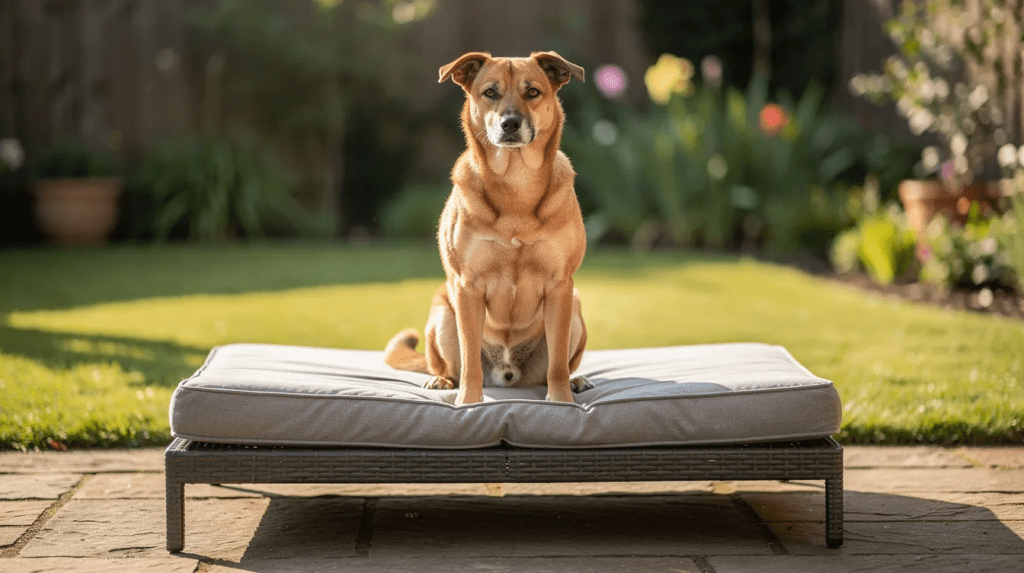
Place Command
The place command teaches your dog to settle on a mat, bed, or raised cot for an extended period. This skill is invaluable for socialization work.
Benefits of a solid place command:
- Promotes impulse control
- Encourages relaxation through structured rest
- Allows calm observation from afar
- Gives your dog a clear job rather than scanning for threats
Practice this at home first, then gradually add distractions. A dog who can hold a place command while watching the world from a safe distance is practicing exactly the skill they need for calmer public behavior.
Focus Exercises
Teaching your dog’s focus on you rather than triggers changes the entire dynamic of stressful situations.
Simple eye contact exercises work well:
- Hold a treat near your eyes
- Mark and reward when your dog makes eye contact
- Practice until this becomes automatic
With repetition, many dogs learn to look back at the handler more quickly instead of locking onto a trigger. The goal is to make checking in with you a familiar habit before the dog becomes overwhelmed.
Progressive Training Environment
Master each skill in this order:
- Zero distraction (inside your home)
- Low distraction (empty park, quiet street)
- Medium distraction (some activity nearby)
- High distraction (distant dogs, people walking)
Build each skill gradually and wait until your dog is succeeding most of the time before increasing difficulty. If your dog cannot respond in a low-distraction setting, they are not ready to perform the same skill around dogs, strangers, or busy public areas.
Regular exercise often helps dogs feel more settled, making it easier for them to focus during training. A dog who has appropriate physical outlets may be better prepared to learn, but exercise alone does not fix aggression or reactivity. It should support, not replace, structured behavior work.
Mental Stimulation at Home
Options include:
- Puzzle toys that challenge problem-solving
- Food-dispensing toys for meals
- Nosework games using scent
- Short training drills throughout the day
Mental enrichment is not just a bonus. Puzzle toys, food-dispensing toys, nosework games, and short training drills can reduce boredom and frustration at home. Meeting your dog’s basic needs creates a calmer foundation for public exposure and behavior work.
Signs Your Dog Needs More Help First
Learning to read early stress signals prevents aggressive outbursts and keeps socialization safe for everyone. If you push past these signs, you risk making behavior worse instead of better.
Subtle Warning Signs
Early warning signs of stress in dogs include stiff body posture, showing the whites of the eyes, lip licking, or hard staring.
Watch for these signals that your dog may be approaching threshold: lip licking when there is no food present, yawning when not tired, stiff body posture, tense muscles, pinned ears, whale eye, averted gaze, a slow stiff tail wag, or refusing treats they normally like. These signs do not always mean aggression, but they can show discomfort or rising stress.
When your dog barks at another dog or person, that is already past threshold. The goal is catching signs before that point.
Overt Warning Signs
If subtle signs are missed, behavior escalates:
- Freezing completely still (decision point)
- Growling (clear warning)
- Snarling with teeth visible
- Lunging on the leash
- Air snapping
- Biting (last resort)
It is important to never punish a dog for growling or snarling, as these are warning signals that could lead to more severe aggression if ignored. A growl is communication. Punishing it removes the warning without changing the dog’s emotional response, making a bite more likely to come “out of nowhere.”
The Danger of Pushing Too Fast
Ignoring stress signals increases the chance that a dog will escalate. Dogs often show discomfort before they growl, snap, or bite. When those early signs are missed or punished, the dog may move to stronger behaviors because the situation still feels unsafe.
When you force interaction with a fearful dog or push them into situations they cannot handle:
- Trust erodes between you and your dog
- Fear pathways strengthen in the brain
- Future recovery takes longer
- Bite risk increases significantly
To effectively manage aggressive behavior in dogs, it is crucial to keep them sub-threshold, meaning they should not be allowed to rehearse aggressive behaviors during training sessions.
Tracking Progress
Keeping a “trigger journal” can help track specific stimuli that cause reactions in dogs and the distance at which they begin to react.
After each walk or training session, note:
- What triggered a reaction (another dog, person, bicycle, etc.)
- How close the trigger was when signs appeared
- How long recovery took
- Intensity on a 1 to 10 scale
If signals persist at 100 or more feet or recovery exceeds 2 minutes, foundational work should come before any close social exposure. Relaxation protocols at home may need to precede outdoor work.
When the Foundation Is Not Ready
Signs that your dog needs more foundational behavior modification before social exposure:
- Dog reacts even at very large distances (100+ feet)
- Recovery takes more than 2 minutes
- You feel fearful or out of control during outings
- Incidents are becoming more frequent or intense
If the owner feels fearful, out of control, or uncertain about safety, that is itself a strong sign that more structured professional help is needed.
When Professional Training May Help
Dog aggression and severe reactivity are complex issues that often benefit from professional support and a customized behavior modification training plan. Attempting to handle serious aggression issues alone carries real risks.
When to Seek Professional Guidance
Consulting a certified dog behaviorist or trainer is recommended to assess the root cause of aggressive behavior and design a personalized safety and training plan.
Consider professional dog trainer support when:
- Your dog has a bite history (even air snaps count)
- Repeated lunging at people or other animals has nearly caused injury
- Incidents are escalating despite your efforts
- You feel unsafe during walks or public outings
- You are unsure whether the aggression is fear-based, frustration-based, or something else
Trying to manage serious aggression alone can be difficult because owners may miss subtle body language, use the wrong distance, or accidentally push the dog too fast. Professional support can make the process safer and more structured.
What Professionals Offer
It is essential to seek the guidance of a qualified professional when dealing with aggressive behavior in dogs, as misinterpretation of a dog’s actions can lead to ineffective or harmful training approaches.
A qualified trainer can:
- Observe your dog in person across different situations
- Identify whether the behavior appears fear-based, frustration-based, territorial, resource-related, pain-related, or linked to poor social experiences.
- Distinguish between reactivity and true aggression
- Design specific step-by-step exercises for your individual dog
- Adjust the training plan in real-time based on your dog’s responses
Behavior modification for aggressive dogs often requires a tailored training plan that can adapt to the dog’s responses in real-time, as each dog’s behavior can vary significantly from session to session. A successful training plan for aggressive dogs should be flexible, allowing adjustments based on the dog’s reactions and progress during sessions.
What Professional Programs Include
Utilizing professional help, such as attending training classes or working with a certified behaviorist, can provide safe, science-backed methods for handling aggressive dogs.
Programs may include:
- In-home training to address behavior where it happens
- Real-world leash control practice
- Structured exposure around distractions in controlled environments
- Muzzle conditioning for safety
- Helper dog setups for controlled parallel work
Structured professional programs may include careful assessment, safety planning, controlled exposure, obedience work, and owner coaching. The goal is to reduce risk while helping the dog build calmer responses over time.
What to Ask Any Professional Trainer
Before working with any professional trainer, ask about their approach:
- How do they prioritize safety during training?
- What positive reinforcement methods do they use?
- How do they handle setbacks or bad days?
- What is their experience with fear aggression specifically?
- Do they use calm exposure and gradual desensitization?
Avoid approaches that rely mainly on fear, intimidation, or harsh corrections. These methods may suppress warning signs without addressing the dog’s emotional response, which can make behavior harder to predict. Look for a trainer who explains safety clearly, works at the dog’s pace, and uses structured, humane behavior modification.
Look for credentials like CPDT-KA or IAABC membership, and trainers who emphasize LIMA (Least Intrusive, Minimally Aversive) approaches.
Why Early Help Matters
Getting expert help early often prevents repeated scary experiences for everyone involved and makes future social outings more predictable and less stressful.
A new dog or rescue dog with unknown history may especially benefit from professional assessment before attempting socialization. Many rescue dogs come with behavioral issues that require specialized approaches.
Muzzle training helps dogs become comfortable wearing a basket muzzle that allows them to pant and take treats while reducing bite risk. The key is conditioning your dog gradually with food and positive experiences before using the muzzle in public. Some dogs adjust quickly, while others need more time.
Final Thoughts
Learning how to socialize an aggressive dog safely is not about quick fixes or forcing your dog to accept every situation. Effective socialization for aggressive or highly reactive dogs centers on distance, calm exposure, leash control, and reliable obedience skills under distractions.
Forcing greetings, rushing into crowded environments, or hoping problems will fade on their own can make dog aggression worse instead of better. Social dogs are not made by flooding them with overwhelming experiences. They are built through patient, structured exposure that respects their emotional limits.
Move at your dog’s pace. Reward calm behavior consistently. Celebrate small wins like calm observation at a distance or a quick recovery after spotting a trigger. Accept that some dogs may never enjoy close contact with unfamiliar dogs or people, and that is perfectly okay. A dog who feels safe is a happy dog, even if their personal space requirements are larger than average.
The most common mistakes dog owners make include pushing too fast, ignoring stress signals, and assuming one good day means the problem is solved. Build confidence through consistency, not pressure.
If you are worried about aggression, reactivity, or unsafe public behavior, reaching out to a qualified dog trainer for professional guidance can provide the structured support and individualized training plan your dog needs. You do not have to figure this out alone, and getting help early makes every future outing safer for your dog, for you, and for everyone you encounter.
FAQ
These questions address concerns that many dog owners have about managing aggressive behavior that were not fully covered in the main sections above.
How long does it usually take to see progress with an aggressive dog?
Timelines vary widely based on your dog’s history, specific triggers, and how consistently training is practiced. Some dogs with mild reactivity show improvement in 2 to 6 weeks. Dogs with severe aggression or deep-seated fear may need 3 to 12 months of consistent work before significant change becomes visible.
Early signs of progress often include quicker recovery after encountering triggers, fewer outbursts during walks, and calmer body language at distances that used to be stressful. A dog who recovered in 2 minutes might start recovering in 30 seconds. A dog who lunged at 80 feet might stay calm at 50 feet.
Focus on steady improvement rather than expecting a quick “cure” for dog aggression. Small dogs and adult dogs alike can make progress, but the timeline depends on individual factors rather than any standard formula.
Is it safe to use a muzzle when socialising an aggressive dog?
A properly fitted basket muzzle can be a valuable safety tool for dogs with a bite history or serious reactivity when working on calm exposure. Using safety tools such as a properly fitted basket muzzle and a secure harness is recommended for dogs with a bite history or who are difficult to control during public outings.
Muzzle training helps dogs become comfortable with wearing a basket muzzle, allowing them to pant and take treats while preventing bites. The key is conditioning your dog to enjoy wearing the muzzle through gradual introduction with food and positive experiences. Some dogs adjust quickly, while others need more time, so move at your dog’s pace.
A muzzle adds a safety layer but does not replace leash control, obedience, distance, or thoughtful behavior modification. It is one tool in a larger safety plan, not a solution by itself.
Should my aggressive dog ever go to a dog park?
Most dogs with aggression or high reactivity are not good candidates for crowded, off leash dog parks where unexpected dog approaches can trigger unsafe behavior. The unpredictable nature of dog parks, with strange dogs running freely and sudden approaches, creates exactly the conditions that escalate aggressive tendencies.
Safer alternatives include:
- Parallel walks with one calm, known dog at a distance
- Quiet open spaces where you control who comes close
- Private fenced areas you can rent for exclusive use
- Scheduled meetups with carefully selected, calm dogs
The goal is calm, predictable dog’s exposure, not free-for-all play with unfamiliar dogs. Some dogs with aggression issues may eventually tolerate supervised, controlled interactions with specific dogs they know, but crowded dog parks remain contraindicated for the vast majority of aggressive or reactive dogs.
Can changes at home help with my dog’s aggression in public?
Consistent routines, clear rules, and regular obedience practice at home can reduce overall stress and confusion for your dog. When the home environment is predictable, many dogs become better prepared to handle training around social triggers outside.
Meeting basic needs makes dogs more capable of handling social triggers outside:
- Adequate physical exercise burns off energy that might otherwise fuel reactive behavior
- Mental enrichment through puzzle toys and training prevents boredom-related frustration
- Sufficient rest prevents overtired, irritable responses
- Clear structure at home builds confidence that transfers to public settings
Think of the home environment as the foundation for all later socialization work. A dog who trusts their owner and feels secure at home is better equipped to handle challenges outside.
What should I do if my dog suddenly has a big outburst during a walk?
First, calmly create distance from the trigger as quickly and safely as possible. Do not yank the leash, scold, or stay close to the trigger hoping your dog will “get over it.” Move in the opposite direction using a smooth U-turn. Many dogs begin to settle once enough distance is created, though some may need more time to decompress.
Once your dog is farther away and begins to calm, quietly reward any small signs of relaxation or focus on you. A look in your direction, a soft body, or accepting a treat are all worth rewarding.
After the incident:
- Make a mental note of the distance and situation
- Future sessions should start farther away from similar triggers
- Allow 20 minutes of decompression time with a chew or quiet rest
- Log the incident in your trigger journal
If outbursts feel frequent or unsafe, contact Off Leash K9 Training of Hampton Roads for expert guidance and a personalized training plan. Schedule your consultation and start building safer walks, calmer responses, and better control around triggers.